
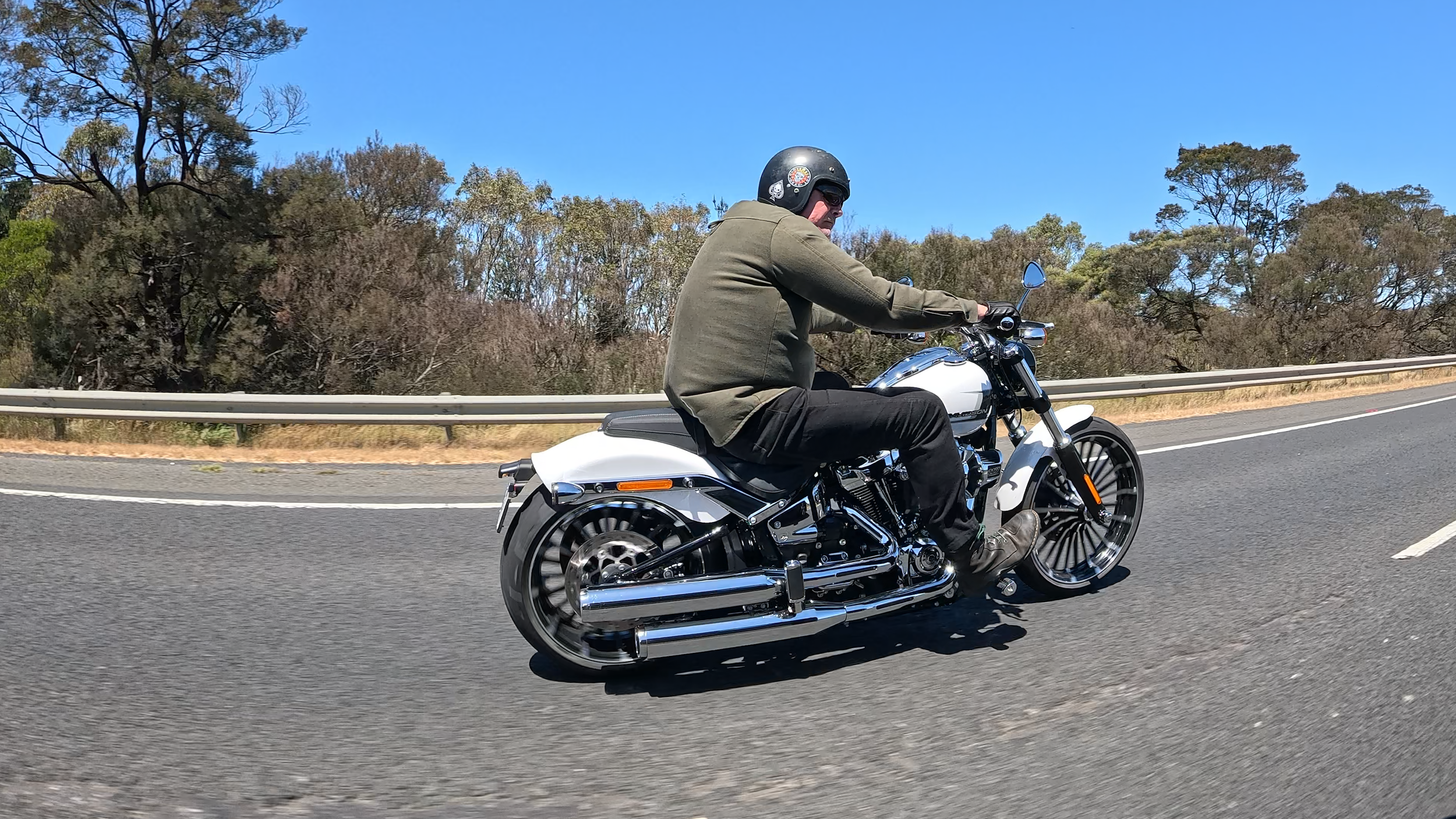
The Harley Davidson Breakout is the bike I keep hearing described as the toughest factory Harley ever built. Not the Heritage, not a black Street Glide, not even the Fat Boy — which is iconic in its own right. The Breakout earns the title with a wider stance, a meaner attitude, and a look that stops people mid-sentence. I recently spent real time on one around Melbourne, and I wanted to answer the questions every rider actually asks: does it turn, is it comfortable, and who's this thing really for.
Why the Breakout Looks Like It Could Start a Fight
The look is the whole story with this bike, and it starts with the numbers. An 18-inch rear wheel wrapped in a 240-wide tyre, a 21-inch front wheel, and the forks raked right out to 34 degrees. That rake is the single biggest reason the Breakout gets its stance. For context, a Fat Boy runs 30 degrees and my Street Glide sits at just 26. The Breakout is raked further than either, and it shows.
The bike I rode was in white onyx, and the paint deserves a mention because photo’s don't do it justice. There's a light metallic fleck through it that catches the sun. Paint's subjective — I usually prefer my Harleys black — but you can't deny this is a genuinely good-looking bike. This particular one came from Harley-Davidson Australia with a stack of Willie G accessories, a tune, and aftermarket mufflers, so it wasn't quite standard. It had the quick-release sissy bar too, though I'd argue the Breakout looks better with a clean rear.
The Engine and the Go
Harley's put their biggest engine — the 117 — in the new Breakout, and it moves. I'm not going to dance around it: traditionally Harley tunes are pretty conservative, but this thing has serious low-down torque. Most people are going to be happy with the pace.
The other night a young guy in a Tesla wanted to have a go from the lights. I genuinely thought he'd kill me, and I dispatched him quickly. I also rode alongside a mate on a touring bike with a nicely tricked-up engine kit, and while his bike is a touch faster, the lighter Breakout had no problem holding acceleration with him. That surprised me in the best way. It's got all the modern features too — traction control, ABS, and brakes that actually work. The days of complaining about Harley brakes are done.
Can a Breakout Actually Corner?
This is the question people always ask, because everyone's heard the Breakout doesn't turn. The truth is somewhere in the middle, and I want to be straight about it.
This is a cruiser, full stop. With that rake and that 240 rear tyre, it is harder to get around corners than a touring bike or a Low Rider — no argument. You've got a lean angle of about 26 degrees, compared to the Street Glide's 32 or 33, and the Low Rider has more still. If you love carving canyons all day, get a Low Rider or a touring bike. The Breakout has neither the lean angle nor the quick turn-in.
But — and this is the honest part — it's not actually a problem. I took it up and down the twisties several times with no issue. I did scrape, but I scrape the Street Glide too, and I weigh a fair bit. I can muscle it through corners. You counter-steer, and it turns. It's slower to turn than a Street Glide, but the idea that a Breakout can't corner is one of those things that gets repeated more than it's actually tested.
The surprising comfort
I expected the stretched riding position to punish me, and it didn't. The forwards controls sit you in a very different position to the floorboards I'm used to, and the wide, straight drag bars mean you're reaching forward with no pullback. It's an aggressive position — you don't get that king-of-the-road feeling you get on a Street Glide with high bars; on the Breakout you get a scowl.
But at my height it's almost perfect. I'm 6'4, so I'd raise the bars a smidge, but if you're around 5'10 to 6'2 it's probably spot on. I've done two-hour stints with no problem, easily fuel-stop to fuel-stop. The seat is firmer than older Harleys — I like a firm seat — and I had zero comfort complaints. You'd want a few thousand kilometres to really judge an aftermarket swap.
One counterintuitive thing: those wide bars make you think you couldn't split traffic, but I found the opposite. It splits faster than the Street Glide, not because it's much thinner, but because it gives the appearance of being thinner. Driver give you room.
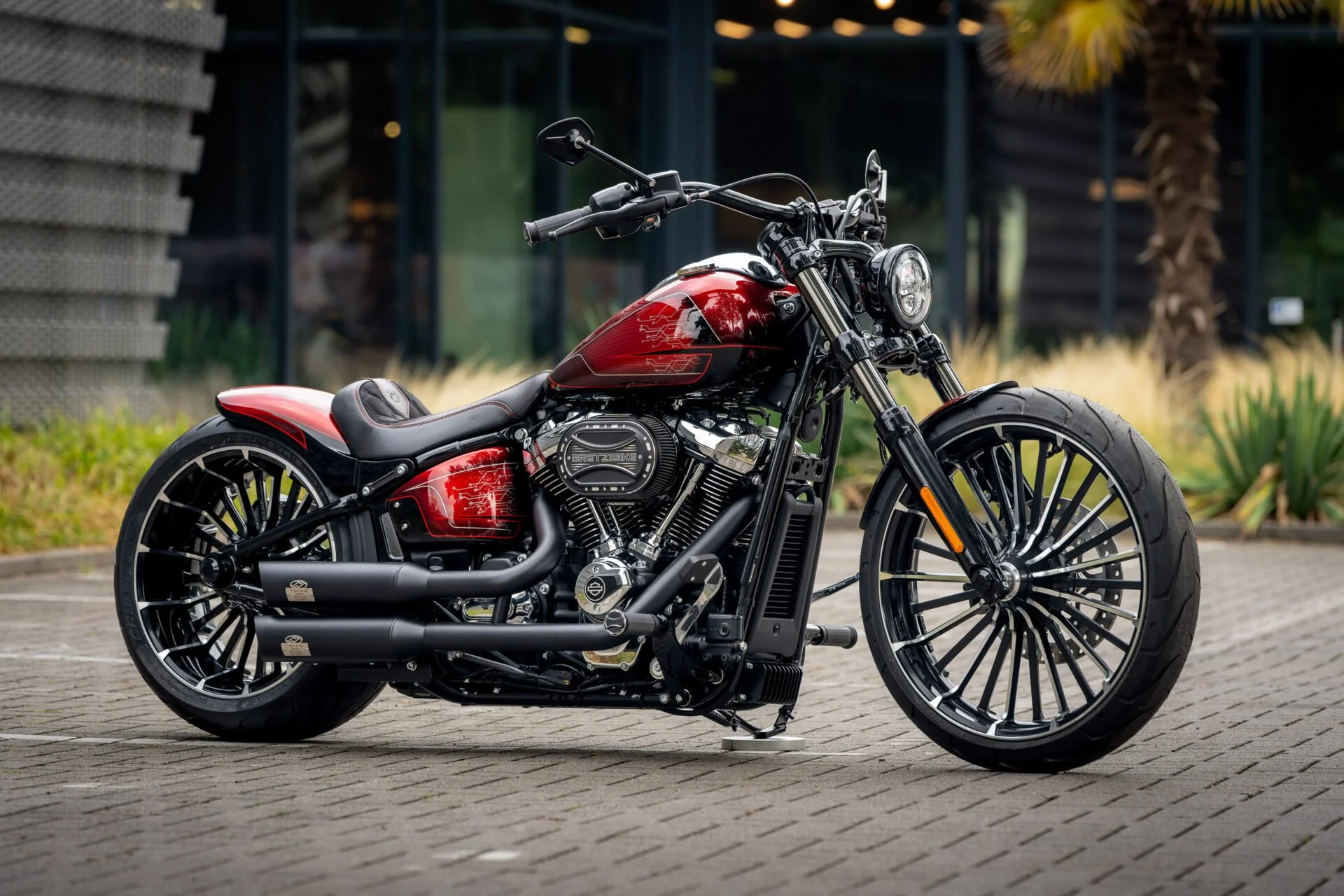
Custom Harley Davidson Breakout By Thunderbike Germany
Who This Bike Is Actually For
If you want a good-looking Harley you can modify into something even better, the Breakout is the platform. I've seen squillions of them tricked up around the world, and that's why I keep hearing it's one of the most popular Harleys in Australia. It's a blank canvas that already looks tough before you touch it.
For anyone who wants a Harley and isn't specifically chasing long touring or savage twisty riding, this bike covers it. You can do almost everything on it and look tough doing it.
The negatives (and I'm nit picking)
I can't find anything that would put you off buying it, so everything here is small.
First, vibration. There's noticeably more through the bars and forwards than on the Street Glide, which I put down to the more solidly mounted forwards controls and the shorter, straighter bars. It's a guess, but you can feel it. No big deal.
Second, that cornering. It's the slowest-turning bike in the Harley line up, but I've said my piece — it still turns fine.
Third, the high-flow air cleaner is a bit bulky, and my leg hits it. If you're shorter than me it's a non-issue. And the looks are subjective — I'd do narrower bars and a different cleaner if it were mine.
That's what makes Harleys fun anyway. There's no wrong answer, just what you'd change. Put it in the comments — what would you do with a Breakout?
If you are interested in how the Harley Davidson Breakout performs against my Street Glide Special check this article out.