

The Fat Boy is the bike that made fat tyres a personality trait. It landed in 1990 and has stayed in the Harley-Davidson line-up ever since, which is a long run for a motorcycle that was originally just a styling exercise with a silly name. I have ridden enough of them to know the appeal is not subtle. Solid disc wheels, a steamroller stance and rubber wide enough to embarrass a small car. This guide walks through the whole family tree, from the Evo years through Twin Cam, the Fat Boy Lo, and the modern Milwaukee-Eight Softail, with a used buying section for each era.
Why the Fat Boy Still Matters
Harley-Davidson calls it the original fat custom icon, and that is about as accurate as marketing gets. The current bike runs a 240mm rear tyre and a 160mm front tyre wrapped around solid disc wheels, which is the visual signature that has carried through three decades of model changes. The stance is what Harley describes as a steamroller look, and it is the reason the Fat Boy photographs better than almost anything else in the showroom. It is not the lightest or the sharpest cruiser in the range, but it has never pretended to be.
The 1990s: Where It All Started
The Harley Davidson Fat Boy debuted in 1990, which makes the earliest examples genuine modern classics now. The 1990s bikes ran the Evolution V-twin of the period and carried the same chunky silhouette that still defines the model, just with much narrower rubber than you get today. These are the bikes that built the reputation, and they are also the ones getting hardest to find in original condition. Plenty have been chopped, repainted or hotted up over the years, which is fine if you like that, but it does mean clean standard examples carry a premium. I have covered the early bike in more detail in the 1991 Fat Boy article if you want the deep dive on the first generation.
The Grey Ghost and the 2025 tribute
If one image defines the early Fat Boy, it's the "Grey Ghost" — the 1991 bike in its soft grey paint with polished silver disc wheels. Combined with the Fat Boy's movie moment around the same era, that grey-and-silver look became shorthand for the model, and for a certain era of Harley as a whole. It's one of the reasons the Fat Boy reads as instantly classic rather than just old.
Harley clearly knows it. For 2025 the company released a limited "Grey Ghost" tribute Fat Boy, reprising the two-tone grey and disc-wheel styling with the modern Milwaukee-Eight 117 underneath. It's a bike aimed squarely at riders who remember the original and want the look without trading away the modern motor, brakes, and ride.
The movie that made the Harley Davidson Fat Boy famous
If the "Grey Ghost" gave the Fat Boy its look, Terminator 2 gave it its myth. The 1990 Fat Boy (and its near-identical but black 1991 successor) that Arnold Schwarzenegger rode in T2 is one of the most-recognised motorcycles in film history — the money shot of him popping the bike off the pavement is burned into a generation of riders' memories. And it wasn't just good press for one model.
T2 hit at exactly the right moment to push the whole brand forward. The Harley of the late 80s and early 90s was already shedding its rough-around-the-edges reputation, and the T2 Fat Boy made the company's bikes look cool, tough, and mainstream all at once. Harley-Davidson wasn't hurting before the film, but the T2 Fat Boy turned the model from a niche Softail into a cultural icon — and plenty of riders who bought their first Harley in the 90s will straight up tell you the Terminator bike is why they got into it.

Harley Davidson Fat Boy in the movie Terminator 2
The 2000s: Twin Cam Takes Over
By the 2000s the Fat Boy had moved onto the Twin Cam engine family, and the model settled into the role of the big-selling cruiser in the range. In used listings you will often see this era advertised as the Fat Boy 96 (FLSTF), which is a useful shorthand when you are scanning classifieds for the right bike. The Twin Cam years brought incremental changes rather than a reinvention, which is good news for buyers. Parts availability is strong, the bikes are well understood by independent workshops, and there is no shortage of them on the second-hand market.

2010 Harley Davidson Fat Boy Lo
2010 and the Fat Boy Lo
In 2010 Harley-Davidson added the Fat Boy Lo to the line-up, a lower take on the same formula, as the badge suggests. It gave riders who found the standard bike a stretch a version that sat closer to the ground without losing the wide-tyre presence. The Lo has built its own following since, and it is worth knowing the differences before you start comparing listings, because the two models are often priced similarly on the used market despite riding quite differently. I went through the Lo in detail in the 2010 Fat Boy Lo article.
I had to mention it as it’s one of my all time favourite motorcycles, that I have owned. The example in the picture above didn’t take much to customise and turn into a fast sharp looking bike at all. I regret selling it.
The Milwaukee-Eight Era
The modern Fat Boy runs the Milwaukee-Eight 114, and Harley's own description makes a point of it being lighter than the previous generation Fat Boy 114 while still slinging torque from that engine. Figures published for the earlier Milwaukee-Eight era give a clear picture of the package: an air and oil cooled four-stroke V-twin in 1745cc or 1868cc form, a 675mm seat height, 317kg wet, and an 18.9L fuel tank. That is a lot of motorcycle to move around a garage, so sit on one before you commit. The weight is carried low, but 317kg is 317kg.
What the 2026 Model Brings
The 2026 Harley Davidson Fat Boy keeps the steamroller stance and adds new paint options, a unique tank medallion and full LED lighting across the bike. It is a refresh rather than a rethink, which tells you Harley knows better than to mess with the shape. If you are shopping new, this is the version sitting in dealerships, and the LED lighting is a genuine practical improvement for anyone riding at dusk or in traffic. New paint and trim details are the kind of thing that matters more in person than in a spec sheet, so go and look at one.
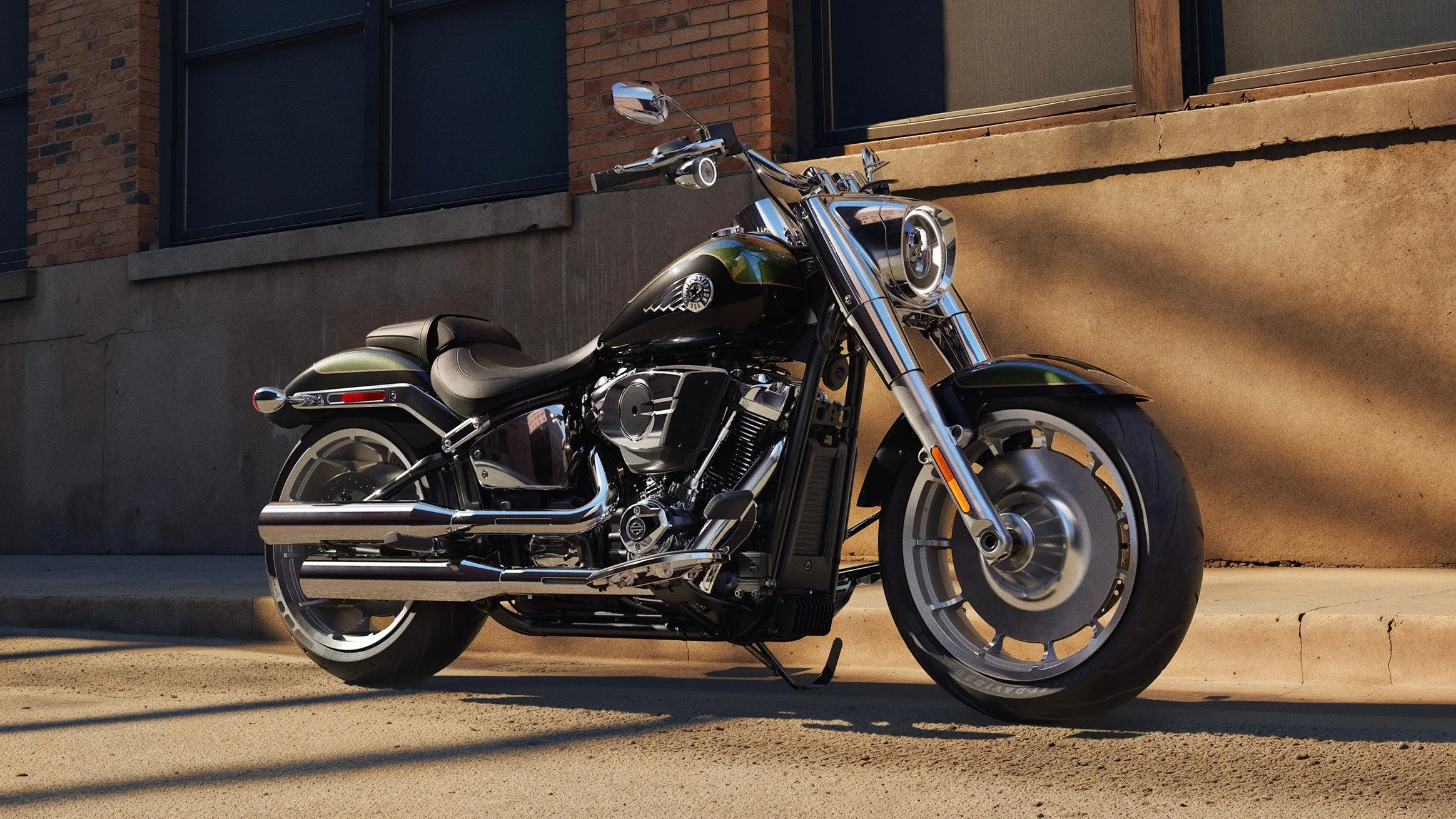
2026 Harley Davidson Fat Boy
Fat Boy Pricing in Australia
Prices move, and they move more on used bikes than new ones, so treat the following as a snapshot rather than a rule. The 2025 Fat Boy was advertised from $32,990, and a published figure for the earlier Milwaukee-Eight range started at $30,995 ride away. On the used side, a Fat Boy 96 (FLSTF) was listed at $17,990. That spread tells the story of the model nicely: the older Twin Cam bikes are now genuinely affordable, while the current generation still commands new-bike money. I think if you are looking for a bargin then the twin cam models are the way to go, often priced less then the earlier Evo model.

You have to laugh when you see pictures of yourself “back in the day” 1990’s Harley Davidson Fat Boy
Used Fat Boy Buyers Guide by Era
Every era of Fat Boy asks a different question of the buyer. Here is how I would approach each one.
1990s Evo bikes
Buy on originality and paperwork rather than mileage alone. These bikes have had decades of owners, and modified examples are everywhere. Ask what has been changed, keep an eye out for factory parts that have been swapped and lost, and check that the numbers line up. A standard, well-documented Evo Fat Boy is the one that will hold value, and it is the one that feels most like the original idea.
At the moment here in Australia owners of Evo’s are holding the prices high (compared to the United States) but the Evo’s don’t seem to be selling at those prices unless they are in original condition.
2000s Twin Cam bikes
This is the value sweet spot. Absolute bargins to be had in Australia. The Fat Boy 96 (FLSTF) generation is common enough that you can walk away from anything questionable, and independent workshops know them well. Service history matters more than kilometres here. Look for a bike that has been ridden regularly rather than one that has sat for years, and budget for consumables on anything that has been parked up.
The 2010 Fat Boy Lo
Check the riding position suits you before anything else, because the whole point of the Lo is the lower stance. Beyond that, treat it like any other Twin Cam era bike, with the usual attention to service records and condition. Because the Lo has its own fan base, clean examples can be priced close to standard Fat Boys, so compare both before you commit.
Modern Milwaukee-Eight bikes
These are the ones still worth real money, so insist on a full service history and confirm the specification for the exact model year. The 317kg wet weight and 240mm rear tyre are part of the deal, not a fault, but they do mean tyre costs add up. Sitting on one and moving it around a car park will tell you more than any spec sheet.
What to Check Before You Buy
Service records, ideally from a Harley dealer or a known independent workshop.
Condition of that wide rear tyre, since replacement is a regular cost on these bikes.
Whether the bike has been modified, and whether the original parts come with it.
Paperwork and number matching, especially on 1990s examples.
The exact specification for the model year, confirmed with a dealer rather than a seller's memory.
If you are planning to modify rather than restore, have a read of the custom Fat Boy build article before you start spending. It is cheaper to learn from someone else's receipts.
Frequently Asked Questions
What year did the Harley-Davidson Fat Boy come out?
The Fat Boy debuted in 1990 and has been part of the Harley-Davidson line-up ever since, which makes the earliest examples genuine modern classics. That 1990 starting point also explains why the Evo era bikes are now the ones collectors chase, while the Twin Cam and Milwaukee-Eight generations still make up the bulk of used stock.
How big is the Fat Boy fuel tank?
Published specifications for the Milwaukee-Eight era Fat Boy list an 18.9L fuel capacity. Harley has revised details across model years, so check the figure for the exact bike you are looking at rather than assuming it carries across every generation. Your owner's manual or a dealer will confirm it.
Is the Fat Boy a hard bike to ride?
Hard is the wrong word. Heavy is the right one. At 317kg wet with a 240mm rear tyre, it rewards smooth inputs and planning, and it is not the bike I would pick for tight low-speed work until you are used to the mass. Once moving, it is stable and relaxed.
Should I buy a used Twin Cam or a newer Milwaukee-Eight Fat Boy?
It comes down to budget and how much you value the newer engine and lighting. A used Fat Boy 96 (FLSTF) gives you the same silhouette for far less money, while the Milwaukee-Eight generation brings the current engine and a lighter package than the previous generation Fat Boy 114. Ride both before deciding.
Whatever era you land on, the Fat Boy rewards a buyer who does the boring homework first. Check the paperwork, confirm the specification for that exact model year with a dealer, and ride the thing properly before you hand over money. Do that and you end up with one of the most recognisable shapes Harley-Davidson has ever built, which is exactly why the model has survived since 1990.